
Certificates of Analysis (COAs) are supposed to answer a simple question: Has this product actually been tested by an independent laboratory?
Unfortunately, in the peptide and research compound market, COAs are one of the most abused and misunderstood documents. Many so-called “COAs” are not analytical reports at all – they are marketing artifacts designed to look scientific without providing real verification.
Knowing how to spot a fake or meaningless COA is critical for clinics, professionals, and informed buyers who care about quality, consistency, and credibility.
If you want to see what real, independently verifiable COAs look like, you can view our COA library here: Certificates of Analysis (COAs) .
What a Real COA Is (and What It Is Not)
A real Certificate of Analysis is a batch-specific analytical report produced by an independent laboratory using defined testing methodologies.
It is not:
- A generic PDF reused across products
- A manufacturer “spec sheet”
- A document without traceable lab attribution
- A purity claim without methodology
If a document exists primarily to reassure customers rather than to document analytical results, it is not functioning as a real COA.
The Two Biggest Things Fake COAs Can’t Replicate
If you only remember two criteria, make it these:
- Authenticity verification – a QR code or verification link that lets you confirm the report on the laboratory’s own website
- Authorization – a signature or sign-off by an accountable person (analyst, QA reviewer, lab director, or authorized representative)
A PDF that cannot be verified externally, and is not signed or authorized, is closer to a marketing document than a real COA.
Red Flag #1 – No Independent Laboratory Information
One of the most common signs of a fake COA is the absence of clear lab attribution.
A legitimate COA should clearly state:
- The name of the testing laboratory
- Contact information or traceable identifiers
- Clear report identification (report number and date)
Fake COAs often:
- Use vague wording like “tested in-house”
- Omit the lab entirely
- Display a logo without any way to verify it
- Use labs that cannot be found or contacted
If you cannot independently confirm the lab is real and performs analytical testing, the COA provides little value.
Red Flag #2 – No QR Code, Verification Link, or Authenticity Check
This is one of the fastest ways to separate real reports from fake ones.
Many legitimate labs provide a built-in authenticity feature such as:
- A QR code that resolves to the lab’s verification page
- A unique report ID you can enter on the lab’s site
- A direct verification URL controlled by the laboratory (not the supplier)
Why this matters: a supplier can generate a beautiful PDF. They cannot easily fake a verification system that lives on an independent lab’s site.
If the report cannot be verified outside of the supplier’s website or WhatsApp message, treat it as unverified.
Red Flag #3 – No Signature or Authorization
Real COAs are not anonymous. They are signed or authorized because someone is accountable for the work.
Look for:
- A signature (digital or physical)
- The name and title of the person approving the report
- A QA reviewer or lab director sign-off
- A date of approval
Fake COAs often avoid signatures entirely. If nobody is willing to sign the report, it is worth asking why.
Red Flag #4 – No Batch or Sample Identification
Real testing happens on specific samples, not on “the product in general.”
A meaningful COA will reference:
- A batch, lot, or sample identifier
- A testing date
- A report or reference number
Fake COAs often:
- Have no batch or lot reference
- Reuse the same document across multiple products
- Present results as if they apply universally
Without batch-level identification, there is no way to know what was tested or when.
Red Flag #5 – “99%+ Pure” Without Any Methodology
A purity number without context is meaningless.
Real COAs specify:
- The analytical method used (for example: HPLC, LC-MS)
- The parameters of the test
- How purity was determined
Fake COAs often:
- State a purity percentage with no method
- Use rounded or suspiciously perfect numbers
- Avoid mentioning how the result was measured
If the document tells you what the result is but not how it was obtained, skepticism is warranted.
Red Flag #6 – Identical Formatting Across Different Products
A subtle but telling sign of fake COAs is template reuse.
Warning signs include:
- Identical layout across unrelated compounds
- Same wording, same values, different product names
- No compound-specific analytical discussion
Real COAs differ because real compounds differ. Analytical results, retention times, and conclusions vary by molecule and batch.
When everything looks copy-pasted, it probably is.
Red Flag #7 – COAs Used as Marketing Assets
If COAs are front-and-center sales tools rather than technical documentation, that alone should raise questions.
Fake COAs are often:
- Used as sales banners
- Promoted as proof without explanation
- Shared without context or limitations
Legitimate suppliers treat COAs as supporting documentation, not advertising copy.
What Real COAs Actually Look Like
Real Certificates of Analysis tend to be:
- Batch-specific and time-stamped
- Issued by identifiable third-party laboratories
- Clear about the analytical methodology used
- Verifiable via a QR code or lab-controlled authenticity check
- Signed or authorized by an accountable reviewer
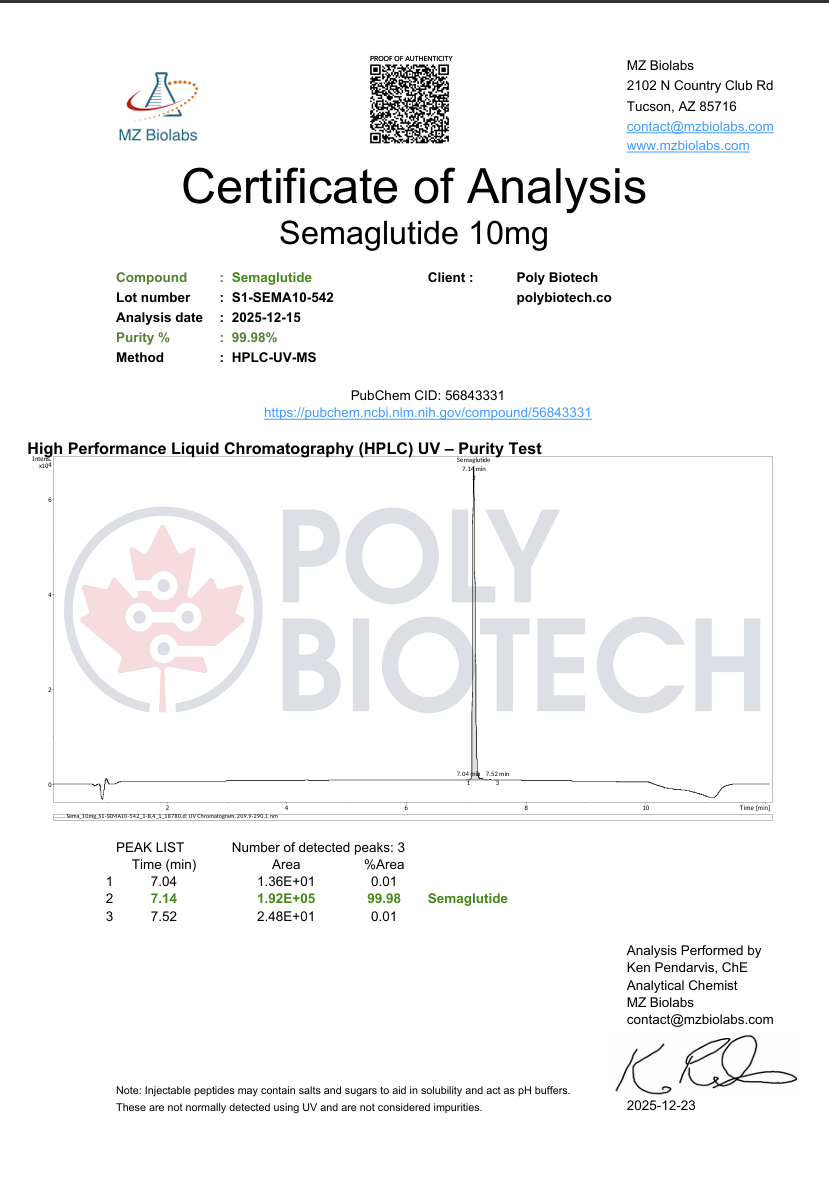
At Poly Biotech, COAs are published selectively and in a structured format because they are meant to support quality verification, not replace professional judgment.
You can view our COA library here: https://www.polybiotech.co/pages/certificates-of-analysis-coas .
Why Fake COAs Exist in the First Place
Fake COAs usually exist for one reason: they are easier than real testing.
Independent analytical testing costs money, takes time, and produces results that cannot be controlled. Creating a generic PDF costs nothing and avoids uncomfortable questions.
Understanding this incentive structure helps explain why fake COAs are so common – and why real ones remain rare.
How to Protect Yourself
When reviewing a COA, always ask:
- Who performed the testing?
- What exactly was tested?
- When was it tested?
- How was it tested?
- Can I verify the report on the lab’s own website (QR code / report ID / verification link)?
- Who signed or authorized the report?
If those questions cannot be answered clearly, the document does not provide meaningful assurance.
Final Thoughts
In markets where regulation is uneven and claims are easy to make, documentation matters – but only when it is real.
Learning how to spot fake COAs protects clinics, professionals, and buyers from relying on false assurances and encourages higher standards across the industry.
Real quality does not hide behind vague PDFs. It stands up to scrutiny.
To view our independently verifiable COAs, visit: Certificates of Analysis (COAs) .